The Aircraft Maintenance Engineering (AME) course duration is generally 2 to 3 years at a DGCA CAR-147-approved institute. Exact period of AME Course depends upon selected AME category and approved training schedule of the institute. It is a basic training period not a fixed deadline to get an AME licence. [1]
For the B1/B2 categories covered on this page, basic training requires 2,000 or 2,400 hours. These training hours include theoretical and practical training. During this course students prepare for applicable DGCA module examinations. [1][2]
After completing relevant training requirements stated scope Certificate of Recognition (CoR). It is not an AME licence. You have to complete applicable maintenance experience and other CAR-66 requirements to get an AME licence. While planning your studies you should check course duration, examination progress and qualifying experience for AME licence. [2][3]
AME Course Duration at a Glance
The table below is providing a clear overview of AME training period, applicable examinations, maintenance experience and licence application. It will help you to understand which requirements are completed during the course and which is to be continued after the basic training. It also explains that there are different stages for course completion and licence eligibility. [1][2][3]
| Stage | Duration or Requirement | What It Means for You |
|---|---|---|
| AME basic training | Generally 2–3 years | You complete the institute’s approved classroom and practical training schedule. [1] |
| Basic training hours | 2,000 or 2,400 hours | The required hours depend on your selected category or subcategory. They are included in the course period. [2] |
| DGCA module examinations | Can run alongside the course | You study the applicable modules and take examinations when eligible and prepared. [1][5] |
| Course completion | After the relevant training requirements are met | You receive the applicable Certificate of Recognition. Check which training or examinations it records. [2] |
| Qualifying maintenance experience | 1 or 2 years, depending on category | You complete relevant maintenance work on operating aircraft. Course practical hours do not automatically satisfy this requirement. [3] |
| AME licence application | After meeting the applicable requirements | You submit your records to DGCA. Licence issuance follows verification. [3] |
Important: Your course completion date and licence-issuance date are different milestones. Qualifying experience may be interspersed with training where CAR-66 conditions are met. It is not necessarily completed entirely after the course. [3]
How Long Is the AME Course in India?
AME basic training generally takes 2 to 3 years, which depends upon the institute’s approved programme schedule. This basic training period includes classroom learning, practical sessions and scheduled training assessments. [1]
DGCA CAR-147 specifies basic minimum training duration into hours. For the categories covered here training hours requirement is 2,000 or 2,400 hours. And institute has to follow same two-year or three-year calendar. [2]
Before admission ask for planned starting and completion dates of the batch. Also check advertised duration includes basic training and other arrangements.
Also confirm that institute training schedule follows the DGCA-approved programme. Training hours and calendar duration are different, so check both before admission.Completing basic training does not by itself mean that you immediately receive an AME licence.You may still need to complete applicable CAR-66 examination and maintenance experience requirements for licensing.
Why Can the AME Course Be 2 or 3 Years?
This difference comes from how the institute schedules the required learning activities. Daily teaching hours, practical sessions, examinations and planned breaks affect the calendar duration of the AME course. So, same institutes required training hours over different periods. A programme may be advertised as two, two-and-a-half or three years. Ask the institute to explain its approved timetable. Do not choose a course based only on the shortest advertised duration. Compare the training hours, practical arrangements and expected completion date.[1]
The overall schedule is designed to provide both theoretical knowledge and practical training. Students need sufficient time to understand aircraft systems, maintenance procedures and safety requirements. The exact sequence of classroom learning, practical sessions and assessments may vary between approved training programmes. Therefore, students should check the complete training schedule before admission. The approved course must cover:
- Theory training: The applicable DGCA module subjects.
- Practical training: Supervised work with tools, components and maintenance procedures.
- Knowledge examinations: Assessment of the relevant module subjects.
- Practical assessments: Demonstration of the required maintenance skills. [2]
AME Course Duration by Category — 2,000 vs 2,400 Hours
Your selected AME category determines the minimum basic training hours. Under the cited CAR-147 Basic requirements, B1.2 requires 2,000 hours. B1.1, B1.3, B1.4 and B2 require 2,400 hours. [2] These training hours cover required learning activities of the selected AME category. According to approved DGCA AME basic programme training it involves theoretical training, practical training and assessments. Exact distribution of these activities vary upon approved training programmes. So, students should check category-specific training plans.
| AME Category | Aircraft or Systems Covered | Minimum Basic Training |
|---|---|---|
| B1.1 | Turbine-powered aeroplanes | 2,400 hours |
| B1.2 | Piston-powered aeroplanes | 2,000 hours |
| B1.3 | Turbine-powered helicopters | 2,400 hours |
| B1.4 | Piston-powered helicopters | 2,400 hours |
| B2 | Electrical and avionics systems | 2,400 hours |
Training hours and calendar years are not interchangeable. A 2,000-hour programme does not automatically mean two years. A 2,400-hour programme does not automatically mean three years. Your institute’s approved schedule determines how those hours are distributed. [1]
What Do the 2,000 or 2,400 Training Hours Include?
Basic training includes theoretical learning and practical maintenance activities. The approved course includes knowledge examinations and practical assessments. [2] In theory sessions, you learn how aircraft systems work and apply this knowledge in practical sessions.You use tools, follow maintenance manuals, inspect components and carry out supervised maintenance tasks. [1] AME course is not only limited to attend classroom lessons. Students have to complete relevant practical training and demonstrate required skills during assessment.[2]
These training hours give students an opportunity to develop the required knowledge and practical skills according to their selected AME category. Along with theory and practical sessions, assessments help evaluate students’ learning and maintenance skills. Therefore, before admission, check the institute’s approved training schedule to understand the hours allocated to theory, practical training and assessments.
Check how the institute counts training hours. CAR-147 Basic guidance defines a theoretical training hour as 60 minutes of tuition. Breaks, examinations, revision, preparation and aircraft visits are excluded from that definition. These activities can take calendar time, but they should not simply be added to the theoretical teaching total. [2]
Theory and Practical Training During the AME Course
For B1.1, B1.2, B1.3, B1.4 and B2, the cited CAR-147 Basic table specifies a 50–60% theoretical-training ratio. The remaining 40–50% is allocated to practical training. Both form part of the approved programme. [2]
For example, a 2,400-hour course using a 60:40 split would have the following allocation:
| Training Component | Share of Training | Hours |
|---|---|---|
| Theoretical training | 60% | 1,440 hours |
| Practical training | 40% | 960 hours |
| Total | 100% | 2,400 hours |
This is an illustrative calculation, not a fixed allocation for every institute. Check the actual theory and practical hours in your approved course schedule. [1][2]
Theoretical Training
Theoretical training explains how aircraft systems operate and how maintenance procedures are applied. These subjects include electrical and electronic fundamentals, maintenance practices, aerodynamics, human factors and aviation legislation. [1]
Specialist subjects depend upon the selected AME category. Subjects include electrical and electronic fundamentals, maintenance practices, aerodynamics, human factors and aviation legislation of aeroplane or helicopter systems. These subjects are organised through applicable DGCA modules. [1]
Theory is part of AME course duration. DGCA Module examination preparation progress is alongwith this classroom learning. [1]
Practical Training
Practical training workshops and maintenance environments. You work under supervision with aircraft tools, test equipment, components and systems. Students learn to follow maintenance manuals, inspect components and removal and installation tasks. They also carry out relevant checks and tests. Completed work is recorded in maintenance documentation. [1]
Practical assessments check your tool use, inspection skills and ability to follow maintenance instructions. They also assess safe working practices. [2]
Practical training helps students to apply theoretical knowledge to actual maintenance. It develops practical understanding of aircraft components, systems and maintenance procedures. Practical sessions provide training to students to use tools and equipment in real life activities. They have to perform tasks according to maintenance manuals and applicable instructions. Supervision is very important during practical training, because students need to perform maintenance tasks in a safe and correct way. Practical assessment does not only focus on task completion it also focuses on ability to check accuracy, safety and follow maintenance procedures. [1]
Under AMC 147.A.200(d), at least 30% of the practical-training portion should take place in an actual maintenance working environment. This is 30% of practical training—not 30% of the whole course. [2]
In the example above, 30% of 960 practical hours is 288 hours. Those hours sit within the practical allocation. They are not an extra 288 hours added to the 2,400-hour course.
Is the AME Course Semester-Wise or Module-Wise?
DGCA AME syllabus is module-wise not semester wise. AME institute organises syllabus into semesters while Modules define subjects. Semesters organise when you study them and complete practical activities. [4]
Module-wise structure helps students to understand syllabus and required subjects according to selected AME category. Every institute distributes these module syllabus in different semesters as per their approved training schedule. Some modules can be easily covered in while some modules are introduced at the different stages of the course. So, semester structure vary in every institute
Therefore, the semester structure can vary between institutes, but the applicable CAR-66 modules remain the basis of the syllabus.
What Is a Module?
A module is a subject within the CAR-66 syllabus. It specifies the topics and required knowledge level for the relevant licence category.
You study the modules applicable to your category. For example, Module 11 applies to the B1 aeroplane subcategories. Module 12 applies to the B1 helicopter subcategories. Module 13 applies to B2. [3] Examples include: [3]
| Module | Subject |
|---|---|
| Module 3 | Electrical Fundamentals |
| Module 7 | Maintenance Practices |
| Module 9 | Human Factors |
| Module 10 | Aviation Legislation |
| Module 11 | Aeroplane Aerodynamics, Structures and Systems |
| Module 12 | Helicopter Aerodynamics, Structures and Systems |
| Module 13 | Aircraft Aerodynamics, Structures and Systems |
What Is a Semester ?
Semester is teaching period in a course timetable. It includes so many modules which is to be prepared during the semester. It also includes lessons, workshops and practical sessions. A module may extend across more than one semester. The number of semesters and teaching order depend on the institute’s approved schedule. Therefore, do not assume that every AME institute follow the same semester plan. Also remember that passing an internal semester examination does not replace the applicable DGCA module examination, it is must that students should qualify . [4]
Module = what you study.
Semester = when your institute schedules that learning.
AME Semester-Wise Training Structure
An institute may divide its 2–3-year programme into semesters. The modules, practical sessions and assessments assigned to each semester can differ by category and institute. The structure below is illustrative. It shows how learning may progress. It is not a universal DGCA semester timetable. [1][4]
Early Semesters — Foundation Training
Training may progress with maintenance practices, electronics, digital systems and aircraft structures. Category-specific learning has become more detailed. Practical sessions connect students to various tasks such as component inspection, manual use and equipment testing. Both theory and practical learning can be scheduled together.[4]
At this stage students can apply theoretical knowledge on detailed maintenance activities. Practical sessions help students to inspect and maintain aircraft systems and components. Sequences of these subjects can differ according to selected AME category and approved programme.
Middle Semesters — Aircraft Systems and Maintenance
Training may progress to maintenance practices, electronics, digital systems and aircraft structures. Category-specific learning becomes more detailed. Practical sessions connect these subjects with tasks such as component inspection, manual use and equipment testing. Theory and practical learning can be scheduled together. [2][4]
Advanced Semesters — Specialist Training and Assessments
Later semesters cover relevant aircraft, engine or avionics subjects of B1 or B2 category. Students have to continue aircraft and component training. They also complete scheduled practical assessments and outstanding DGCA modules. [2][4]
This stage is more focused on related subjects and systems of selected AME category. Students prepare for applicable examinations of covered modules.
Practical training is not restricted to the final semesters. It is interspersed through theory in whole course. Therefore do not assume that practical work will be started in final year. Ask for the complete timetable rather than assuming that practical work begins only in the final year.
Practical activities are included at different stages of classroom learning. This helps students connect theoretical concepts with maintenance tasks as they progress. Therefore , For detailed subject arrangements, read the AME Semester-Wise Syllabus section of our syllabus page. [4]
DGCA Modules Run Parallel with the AME Course
You do not necessarily need to finish the course before starting DGCA module examinations. You can prepare for and take the applicable modules during basic training. Examination eligibility and the available sessions still apply. [1][5]
This allows your classroom learning and examination progress to run alongside each other. It does not create a separate fixed examination year after the course. However, any modules you have not passed remain outstanding licensing requirements. [1][3]
DGCA’s Pariksha portal handles examination registration and applications. You need an issued Computer Number before applying for module examinations. Applications must be submitted during the relevant examination window. Joining an institute does not replace this process. [5]
Plan your preparation around the subjects being taught. Keep track of the modules you have passed and those still pending. Ask your institute how examination preparation fits into its timetable.
Parallel examinations do not guarantee that every student clears all modules before course completion. Further attempts may require more preparation and a later examination session. [3][5]
Does the 2–3-Year AME Course Give You an AME Licence?
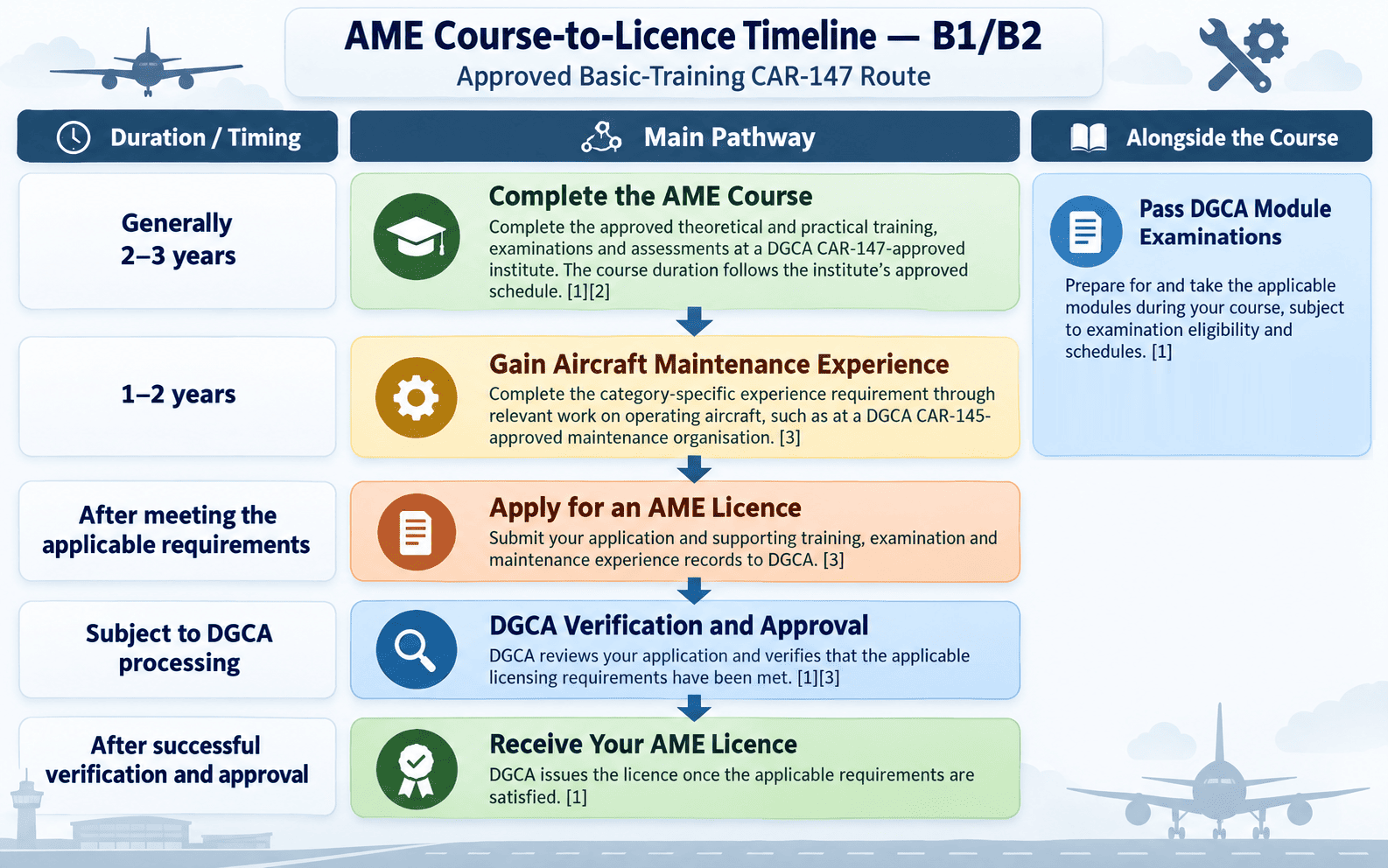
No. Course completion does not automatically give you a DGCA AME licence. For the approved basic-training route covered here, you need to distinguish three requirements. [1][3]
Basic Training
Complete the approved theory, practical training and required assessments. The programme generally follows a 2–3-year schedule, with the applicable 2,000 or 2,400 training hours. The relevant Certificate of Recognition records the training or examinations completed within its scope. It is not the licence itself. [1][2]
DGCA Module Examinations
Pass the applicable modules for your category. These can be taken during the course. Any outstanding examinations still need to be addressed before you meet the licensing requirements. [1][3]
Qualifying Maintenance Experience
Complete the relevant maintenance experience on operating aircraft. Your records must show appropriate tasks for the category and satisfy the applicable experience conditions. DGCA then verifies the application and supporting records. The end of your institute’s timetable does not automatically become your licence-issuance date. [1][3]
Approved training + applicable DGCA modules + qualifying maintenance experience + other CAR-66 requirements → licence application.
How Much Experience Is Required After AME Training?
For students who successfully complete the relevant approved basic training, the basic maintenance experience requirement is one or two years, depending on the licence category. [3]
| Licence Category | Required Qualifying Maintenance Experience |
|---|---|
| B1.1 | 2 years |
| B1.2 | 1 year |
| B1.3 | 2 years |
| B1.4 | 1 year |
| B2 | 2 years |
These periods refer to qualifying maintenance work, not simply time spent at an organisation. The experience must involve operating aircraft and meet the relevant task coverage, record and recency requirements. [3]
Ask your institute what happens after basic training. Check where experience can be gained, when it can begin and how the maintenance tasks will be documented.
Does the AME Course Count as Two Years of Experience?
The course period does not automatically count as two years of aircraft maintenance experience. Successfully completing the relevant CAR-147 approved basic training qualifies you for the reduced experience requirement specified in CAR-66. [3]
For example, a B1.1 student on this route needs two years of qualifying experience. A B1.2 student needs one year. Classroom attendance is not a substitute for that maintenance work. [3]
Can Experience Be Gained During the Course?
Qualifying maintenance experience may be interspersed with approved training, where CAR-66 conditions are met. The work must still satisfy the applicable experience requirements. [3]
This means the experience period is not necessarily completed entirely after graduation. However, course practical hours should not automatically be counted as licensing experience. [1][3]
Before calculating your total timeline, ask which periods of work can qualify and how they will be recorded. Do not simply add every workshop session to your experience record.
AME Course Duration vs AME Licence Duration
Course duration describes your basic training period. The licence timeline describes the complete journey to DGCA licence issuance. Use the comparison below when discussing the programme with an institute. [1][2][3]
| AME Course Duration | AME Licence Timeline |
|---|---|
| Covers the approved basic training programme at a CAR-147-approved institute. [2] | Covers the applicable training, DGCA modules, qualifying experience and licence application. [3] |
| Generally 2–3 years, depending on the approved schedule. [1] | Depends on when you complete the required examinations and experience, followed by application verification. [1][3] |
| Includes 2,000 or 2,400 training hours for the B1/B2 categories covered. [2] | Includes the category-specific qualifying maintenance experience. [3] |
| Includes theory, practical learning and the relevant examinations and assessments. [2] | Requires evidence that the applicable knowledge, experience and other licensing conditions are met. [3] |
| Leads to the relevant Certificate of Recognition, within its stated scope. [2] | Leads to an AME licence issued by DGCA after the applicable requirements are satisfied. [3] |
| Course completion does not itself grant a licence. [1][2] | DGCA reviews the application and supporting records before licence issuance. [3] |
How Can You Estimate the Full Timeline?
Start with the institute’s approved course period. Then check the experience requirement for your category. Establish whether qualifying experience is completed separately or interspersed with training. [1][3]
For B1.1, B1.3 and B2, a 2–3-year course followed by two separate years of experience gives a 4–5-year planning example for those stages.
For B1.2 and B1.4, a 2–3-year course followed by one separate year of experience gives a 3–4-year planning example.
These are calculations using the course and experience periods above. They are not fixed minimum licence timelines. Outstanding modules, gaps between stages and DGCA processing may require additional time. Qualifying experience interspersed with training may change the overall calendar. The actual timeline of the course depends on when you complete the required examinations of the AME category.
The availability of suitable maintenance work can affect how quickly the required experience is accumulated. Students who complete examinations or experience later may need additional time before meeting all requirements.The institute’s course completion date should therefore not be treated as the final licence completion date.
You should track your training, examination and experience requirements separately throughout the process.This gives you a clearer estimate of the time remaining for your AME licence journey.
[1][3]
Why Can the Total AME Licence Timeline Differ Between Students?
Students in the same batch may finish their licensing requirements at different times. Their course timetable may be the same, but examination progress and maintenance experience can differ. [1] The time taken to complete each requirement may also depend on when students finish their applicable examinations and gain the required experience. Some students may complete all requirements during or soon after their basic training, while others may need additional time. Understanding these factors can help you plan your AME licence journey more realistically. The following factors explain why the total licensing timeline may differ from one student to another. in hindi dont change english words [1]
| Factor | Effect on Your Completion Timeline |
|---|---|
| Selected category | Determines the applicable modules and the maintenance tasks relevant to your licence. [3] |
| Minimum training hours | B1.2 requires 2,000 hours. The other B1/B2 categories listed require 2,400 hours. [2] |
| Approved course schedule | The institute’s teaching calendar determines when lessons, practical sessions and assessments are completed. [1] |
| Module examination progress | Outstanding modules may remain after your course finishes. [1][3] |
| Further examination attempts | Retakes may require additional preparation and a later session. Applicable waiting periods and attempt limits must be followed. [3][5] |
| Practical assessments | You must demonstrate the required skills. Attendance alone does not replace an assessed pass. [2] |
| Start of qualifying experience | Experience arrangements affect whether qualifying work begins during training or afterwards. [3] |
| Experience requirement | The approved basic-training route requires one or two years, depending on category. [3] |
| Maintenance records and documents | Incomplete or unclear records may need correction before the requirements can be verified. [3] |
| Licence application and verification | Submission and DGCA verification are separate from course attendance and experience accumulation. [3] |
To plan your progress, track three milestones: completion of basic training, completion of the applicable modules and completion of qualifying experience. Keep the supporting records organised throughout the process.
Before Admission — Check These Duration Details
Ask for a written timetable before paying for an AME programme. It should explain the course period, training hours, practical arrangements and assessments. Also ask what may remain after course completion. [1]
Use this checklist when comparing institutes:
| What to Check | What You Should Ask |
|---|---|
| 1. Current CAR-147 approval | Can I see the current approval certificate? Does it cover the training location where I will study? [2] |
| 2. Approved category | Is my selected B1 subcategory or B2 category included in the approval? [2] |
| 3. Course calendar | Is this batch scheduled for two, two-and-a-half or three years? What are the planned start and completion dates? [1] |
| 4. Total training hours | Does the programme provide the minimum hours required for my category—2,000 or 2,400 hours? [2] |
| 5. Theory and practical allocation | How many hours are assigned to each? What is the weekly timetable? How is missed training completed? [2] |
| 6. Semester schedule | How many semesters are used? Which modules, practical sessions and assessments are scheduled in each? [4] |
| 7. DGCA module examinations | When can I begin applying? What support is available for Computer Number registration, examination applications and preparation? [5] |
| 8. Maintenance-environment training | Where will this training take place? What are the scheduled hours and written arrangements with the maintenance organisation? [2] |
| 9. Qualifying maintenance experience | When can relevant work on operating aircraft begin? Who supervises it? How are tasks recorded? Does the institute arrange an opportunity or only provide application assistance? [3] |
| 10. Requirements after the CoR | What will my certificate record? Which modules, experience requirements or documents may still remain before I apply for the licence? [2][3] |
Ask the institute to show the course completion date separately from the expected completion of examinations and qualifying experience. This gives you a clearer study plan than a single claim such as “AME licence in two years”.
The key distinction is simple: the AME course generally takes 2–3 years, but your complete licence timeline depends on the applicable examinations, qualifying experience and DGCA verification. [1][3]
References & Official Sources
[1] AME CET — Aircraft Maintenance Engineering (AME) Course Details. Relevant sections: “AME Course Duration and Training Hours”, “Why Does the AME Program Duration Differ?”, “AME Course Completion and Licensing Experience”, and “AME Examinations and the DGCA Licence”. Supports the programme-dependent calendar duration and explanations of training and examination arrangements. Read the course details .
[2] Directorate General of Civil Aviation — CAR-147 (Basic), Issue 1, Revision 0, dated 27 December 2017. Relevant provisions: 147.A.140–155; 147.A.200–210; AMC 147.A.200; Appendix I; and Appendix III with its AMC. Covers approval scope, training components, category-wise hours, theoretical-training ratios, practical assessments and Certificates of Recognition. Read the official CAR-147 Basic document .
[3] Directorate General of Civil Aviation — CAR-66, Issue III, Revision 2, dated 29 September 2025. Relevant provisions: 66.A.10, 66.A.25, 66.A.30, AMC 66.A.30(a), and Appendices I and II. Covers applications, module requirements, maintenance experience and examination standards. Read the externally hosted reproduction of the DGCA document . DGCA’s public notice dated 26 February 2026 confirms use of this edition’s syllabus for the March 2026 examination session.
[4] AME CET — Aircraft Maintenance Engineering (AME) Course Syllabus. Relevant sections: “Is the AME Syllabus Semester-Wise or Module-Wise?”, “AME Semester-Wise Syllabus”, and “Practical Training in the AME Course”. Supports the distinction between modules and semesters and the illustrative teaching progression. Read the AME syllabus .
[5] DGCA Pariksha — AME Examination FAQs. Relevant FAQs: 2, 4, 39, 58 and 67. Explains registration for enrolled basic-training students, Computer Numbers, examination application windows and module examination applications. Read the official examination FAQs .