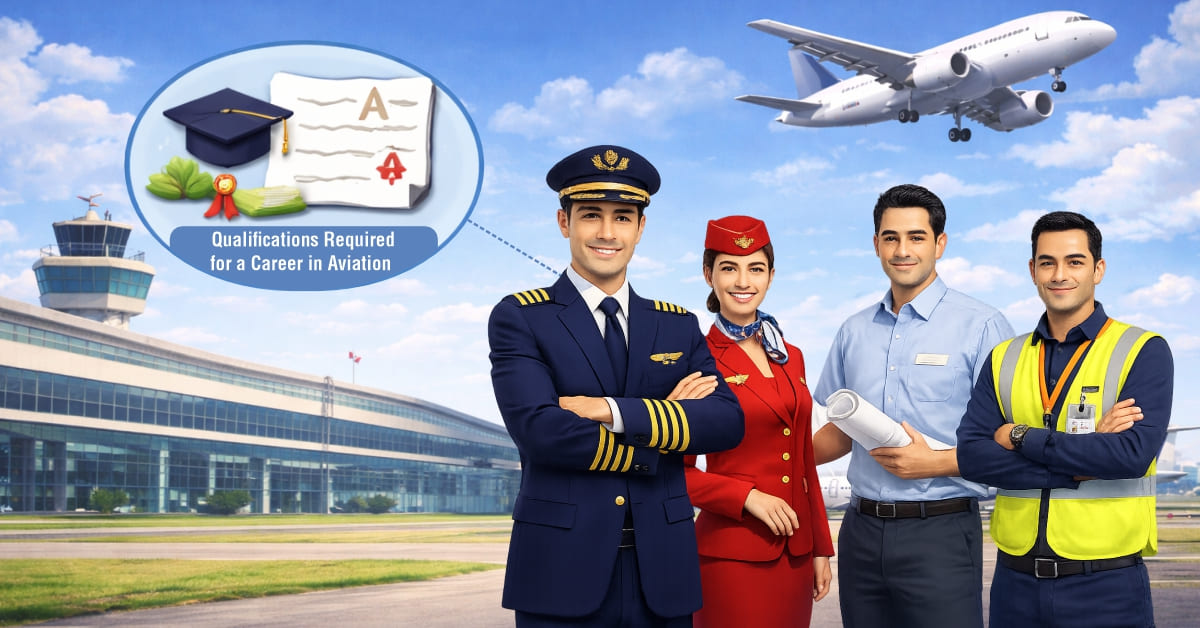
What are the qualifications needed for a career in aviation?
Posted on : 28 January, 2026 06:19 pm
The aviation sector presents a wide variety of career options, ranging from piloting aircraft to operating on the ground to maintain the seamless flow of airports and air traffic. The requirements are quite diverse depending on the particular career option pursued. The following is a clear explanation of the educational, physical, and skill-based requirements for various careers in the aviation sector.
1. Educational Qualifications
1.1. Pilots
To become a pilot, commercial or private, certain training and licenses are needed:
- Minimum Education: 10+2 with Physics, Mathematics (Science stream is essential).
- Additional Courses: Bachelors degree is not essential but preferred.
Flight Training: Joining a DGCA-approved flying school (in India) or FAA/EASA-approved school (overseas). Licensing:
- Student Pilot License (SPL)
- Private Pilot License (PPL)
- Commercial Pilot License (CPL)
1.2. For Cabin Crew
Cabin crew personnel (air hostesses/flight attendants) take care of the passengers safety and comfort during air travel.
- Minimum Educational Qualification: 10+2 (any stream).
- Preferred: A diploma or graduation in hospitality, travel, or tourism may be beneficial.
- Training: Most airlines provide in-house training after selection, but cabin crew training institutes are also present.
1.3. For Aircraft Maintenance Engineers (AME)
AMEs are tasked with maintaining and certifying an aircraft to fly.
- Minimum Educational Qualification: 10+2 with Physics, Chemistry, and Mathematics.
- Training: 2 to 4 years training from DGCA-approved AME schools.
- License: Grant a license in Category A, B1 (mechanical), or B2 (avionics) after clearing DGCA modules.
1.4. For Air Traffic Controllers (ATC)
ATCs coordinate aircraft movement on the ground as well as in the air.
- Minimum Education: Bachelors degree in engineering (electronics, telecommunication, electrical, or computer science), physics, or mathematics.
- Recruitment: Recruitment in India is through Airports Authority of India (AAI) exams.
1.5. For Airport Operations and Ground Staff
- These positions involve ticketing, customer service, baggage handling, and logistics.
- Minimum Education: Diploma or 10+2 in airport/airline management.
- Preferred: Graduation in travel and tourism, aviation, or business administration.
2. Physical and Medical Requirements
2.1. Pilots
Vision: 6/6 vision in both eyes (corrective lenses permitted within limits).
- Medical Certification: They must pass the Class I and Class II medicals by doctors approved by DGCA.
- Health Conditions: Free from color blindness, epilepsy, heart conditions, or any condition of consciousness.
2.2. Cabin Crew
Height & Weight: Minimum height (most likely 155–170 cm depending on the airline); weight proportional to height. Vision: Normal vision or corrected vision (within permissible limits). Medical Fitness: No visible tattoo, scars, or contagious diseases. Should clear an airlines medical examination. Swimming: Basic swimming knowledge is required by some airlines for cabin crew.
2.3. AME & ATC
Medical: Fit eyesight, hearing, and general health. Stress Management: Particularly for ATC, withstanding high-pressure situations is extremely important.
3. Skill-Based Qualifications
In addition to educational and medical qualifications, some technical and soft skills are required:
3.1. For Pilots
Excellent Communication: Coordination with air traffic control and crew. Situational Awareness: Quick decision-making under stressful conditions. Leadership and Responsibility: Safety of all passengers and crew. Technical Knowledge: Aerodynamics, meteorology, navigation, etc. understanding.
3.2. For Cabin Crew
Customer Service: Calm and helpful demeanor in emergencies. Multi-tasking: Coordinating safety demonstrations, food service, and emergency procedures. Language Proficiency: English fluency is required; other languages are a bonus.
3.3. For AME
Technical Expertise: Knowledge of aircraft systems, maintenance procedures. Attention to Detail: Ensuring safety through careful checks. Problem-solving Skills: Detection and correction of technical problems promptly.
3.4. For ATC
Decision-Making: On-the-spot decisions to control flight paths and prevent collisions. Concentration: Ability to maintain concentration for extended hours. Communication Skills: Concise and clear communication with pilots.
3.5. For Ground Staff
Interpersonal Skills: Dealing with passengers and complaints. Computer Knowledge: Experience with reservation systems and airport software. Teamwork: Working in coordination with security, baggage, and other airport personnel.
4. Certifications and Extra Training
Numerous careers in aviation are enhanced by or necessitate specialized certifications: IATA Certifications: Provided by the International Air Transport Association in fields such as air cargo, travel and tourism, and handling dangerous goods. DGCA Exams: For Indian pilots and AMEs. EASA/FAA Licenses: For pilots seeking employment abroad.
5. Soft Skills and Personality Traits
Whichever the role, aviation professionals need to develop: Discipline and Punctuality Flexibility Stress Management Multilingual Skills (particularly for international posts) Cultural Sensitivity
Conclusion
A career in aviation can be extremely fulfilling, but it requires a combination of formal schooling, technical training, and personal attributes. Whether you want to be a pilot, cabin crew, or ground staff, each position entails special qualifications and a commitment to safety and excellence. Being aware of the requirements from an early stage assists in selecting the correct academic course and acquiring the skills needed to prosper in this fast-paced and dynamic sector. If you know which specific aviation role youre targeting, I can help outline a personal roadmap for you.