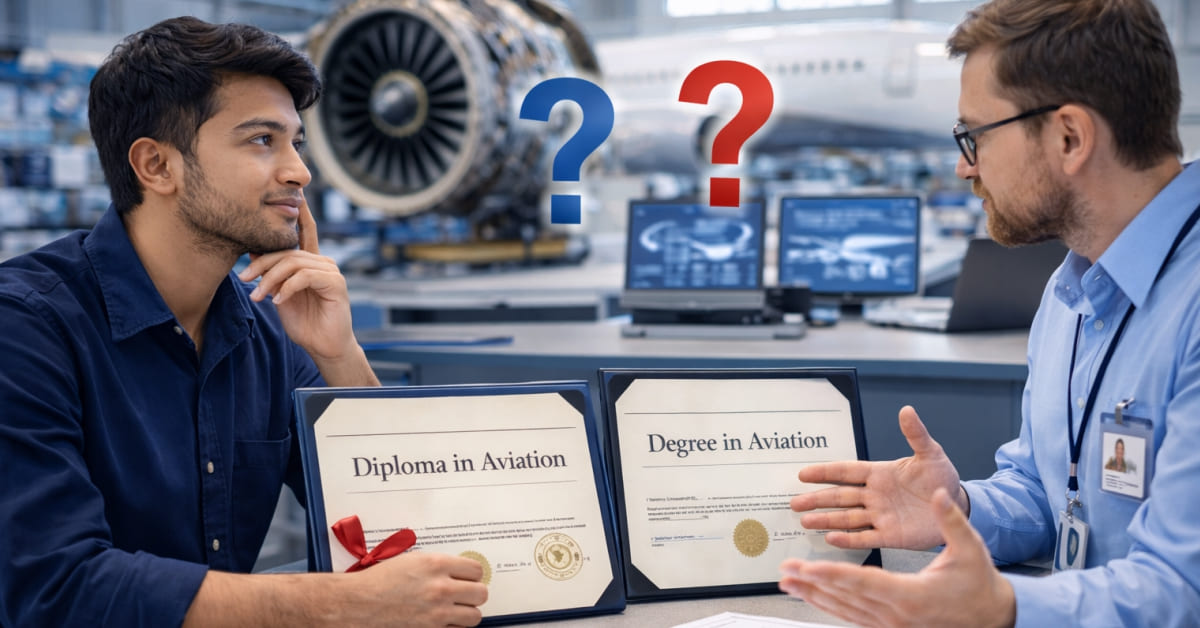
Which is better – a degree or a diploma in aviation?
Posted on : 2 February, 2026 10:23 am
Following a career in aviation is the aspiration of many, but which educational path to follow can be perplexing—particularly between earning a degree or a diploma. Both present worthwhile training and opportunities, but which is best depends upon your career aspirations, expenses, time schedule, and area of specialty. In this article, we will discuss the main differences, benefits, and career opportunities of a degree as opposed to a diploma in aviation, so you can make an educated choice.
1. Knowing the Fundamentals
1.1. What is an Aviation Degree?
An aviation degree is generally a 3 to 4-year undergraduate course studied at universities and aviation colleges. It may consist of: B.Sc. in Aviation BBA/BMS in Aviation Management B.Tech in Aerospace Engineering Bachelors in Aviation Maintenance or Airport Operations These courses merge academic theory with technical skills, frequently with general education courses like mathematics, physics, and communication skills.
1.2. What is a Diploma in Aviation?
A diploma is typically a shorter program (6 months to 2 years) provided by training schools. It emphasizes job-specific training and practical skills in subjects like:
- Cabin crew
- Ground handling
- Airport operations
- Aviation hospitality
- Airfare and ticketing
Diplomas are industry-focused and skill-based, thus opening a fast track in aviation careers.
2. Major Differences Between Degree and Diploma
- Aspect Degree Diploma Duration 3–4 years 6 months – 2 years Cost Moderate to high Lower (budget-friendly) Focus Academic + Technical Job-oriented/Practical Career Scope Broader (long-term growth) Entry-level jobs (faster placement) Recognition Higher (globally accepted) Depends on institute Further Education Eligible for PG (MBA, MSc, etc.) Limited academic progression Best For Management, Engineering, Long-term Careers Quick job seekers in operations
3. Career Opportunities After a Degree
Aviation degrees lead to higher-level and managerial positions, as well as the possibility of postgraduate studies and foreign employment.
3.1. Aviation Management
- Airline operations manager
- Airport terminal manager
- Revenue analyst
- Aviation consultant
3.2. Aerospace Engineering or AME Degree
- Aircraft design engineer
- MRO project lead
- Maintenance supervisor
3.3. Flight Training with Degree
Most future pilots complement a B.Sc. in Aviation with flying training for greater career flexibility.
3.4. Higher Education Pathways
- MBA in Aviation Management
- MSc in Aerospace Engineering
- PG in Logistics or Supply Chain
These are only available for degree holders, and therefore, a degree is a more versatile long-term investment.
4. Career Prospects Following a Diploma
Diploma courses are ideally suited for speedy employment in operational or support positions.
4.1. Cabin Crew
- Air hostess/Flight steward
- Senior cabin crew (experience)
- In-flight supervisor
4.2. Ground Staff and Customer Service
- Check-in agent
- Passenger service agent
- Baggage handling staff
- Airline ticketing executive
4.3. Airport Management (Entry-level)
- Terminal assistant
- Ramp coordinator
- Safety staff
Diploma holders can start building their careers from these positions and move up through internal advancement or additional certifications.
5. Things to Keep in Mind Before Selection
5.1. Career Aspiration
- If you seek higher ranks, international jobs, or wish to take pilot training, a degree is recommended.
- If you wish to begin working immediately and do not mind operational/support positions, a diploma would suit.
5.2. Time and Cost
Degree courses take longer and more money to pursue. Diplomas are cheaper and provide quicker job market entry.
5.3. Recognition
Degrees are accepted at universities and government levels. Recognition for diplomas differs from institute to institute—make sure its DGCA, IATA, or UGC-approved (if available).
5.4. Industry Trends
Aviation employers increasingly prefer skill-based recruitment, but top-level jobs still demand educational qualifications, which benefits degree holders in the long term.
6. Industry Preference: What Do Employers Want?
- Prefer degree holders for management and administrative positions.
- Accept diploma holders for customer service, frontline staff, and crew members.
- MROs and Technical Disciplines
- Prefer AME or B.Tech/B.Sc. degrees for engineering posts.
- Diploma holders can work as technicians or assistants but are restricted in their growth.
- Pilot Training Schools
A degree is not essential but is preferred or required by some cadet programs. Possessing a degree can benefit in non-flying careers such as training, operations, or aviation safety.
7. Advantages and Disadvantages
Degree – Advantage
Suitable for long-term profession
- Internationally accepted
- Fit for post-graduate studies
- Paves way for leadership positions
Degree – Disadvantage
- Time-consuming
- Pricier
- Demands academic success
Diploma – Advantage
- Short route to employment
- Less expensive
- Skill-specific
- Suited for cabin crew and ground staff
Diploma – Disadvantage
- Fewer career opportunities without further study
- Acceptance may be different
Not designed for management or technical engineering posts
8. Combination Approach (Best of Both Worlds)
A few students opt for both: assistant Deleted
Diploma to get work experience first. Degree (online or part-time) to pursue later for career advancement Or: Degree in aviation or engineering and then take short-term diplomas for practical experience, say, cabin crew, airport operations, etc. This hybrid approach would enhance employability at the same time as long-term growth.
Conclusion
There is no one-size-fits-all solution when it comes to opting between an aviation degree or a diploma. It all comes down to your career aspirations, budget, availability of time, and preferences. Opt for a degree if you plan to have a long-term aviation career in leadership, engineering, or international roles. Opt for a diploma if you prefer a quicker kick-off, particularly in operational or cabin crew entry-level positions. Ultimately, both paths can lead to a successful aviation career if you are passionate, committed, and keep upgrading your skills over time.