Role of an Aeronautical Engineer in the Aviation Industry
Posted on : 14 March, 2026 12:46 pm
The aviation industry continues to grow in leaps and bounds, making it one of the most rapidly expanding sectors on a global scale. Aeronautical engineers are central to the aviation industry. These professionals ensure that all flights run smoothly by implementing their creativity, hard work, and technical skill. Their role is fundamental in the design, development, testing, and maintenance of aircraft, which is pivotal to the evolution of air travel.
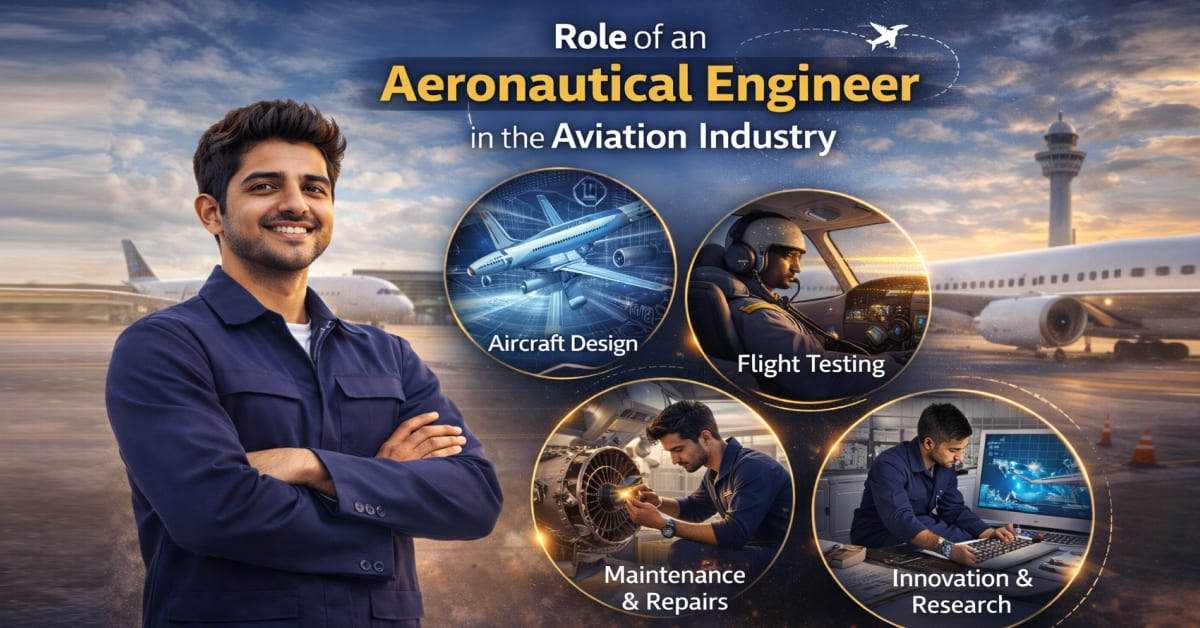
The Design and Development of Aircraft:
Aeronautical engineers are tasked with the development and design of aircraft, which is one of their core functions. These engineers take into consideration the aerodynamics of flight and work on achieving fuel economy through the use of lightweight materials and advanced propulsion systems. Think of cutting-edge aircraft models that not only travel greater distances but do so economically. This is the essence of advanced aircraft engineering.
Ensuring Safety and Dependability:
The aviation sector places the highest importance on safety. Aeronautical engineers have the job of evaluating and testing components of an aircraft under extreme conditions such as during turbulence, high velocity, and rapid changes in pressure. Through the use of simulations, stress testing, and thorough inspections, engineers guarantee that every airplane complies with safety regulations prior to its flight.
Maintenance and Troubleshooting:
Aeronautical engineers are also involved in the maintenance and repair of aircraft. They monitor the performance of engines, control systems, and navigation technologies to prevent technical failures. When an issue arises, they troubleshoot and provide solutions to keep aircraft functioning smoothly.
Research and Innovation:
With growing demand for sustainable aviation, aeronautical engineers play a vital role in researching eco-friendly technologies. They work on developing electric aircraft, fuel-efficient engines, and designs that reduce carbon emissions. Their research contributes to making aviation more sustainable and cost-effective.
Contribution to Defense and Space:
Beyond commercial aviation, aeronautical engineers are also key players in defense and space programs. They design fighter jets, drones, and spacecraft that serve military and exploration purposes. Their expertise ensures advanced technology in national security and space missions.
Collaboration and Global Impact:
Aeronautical engineering is a collaborative field. Engineers often work with pilots, technicians, software developers, and international agencies. Their contributions not only strengthen the aviation industry but also connect people, cultures, and businesses worldwide through safer and faster air travel. The role of an aeronautical engineer extends far beyond designing planes. From ensuring passenger safety to advancing technology and promoting sustainability, their work is central to the aviation industry. As air travel continues to evolve, aeronautical engineers will remain the driving force behind innovation and progress in the skies.