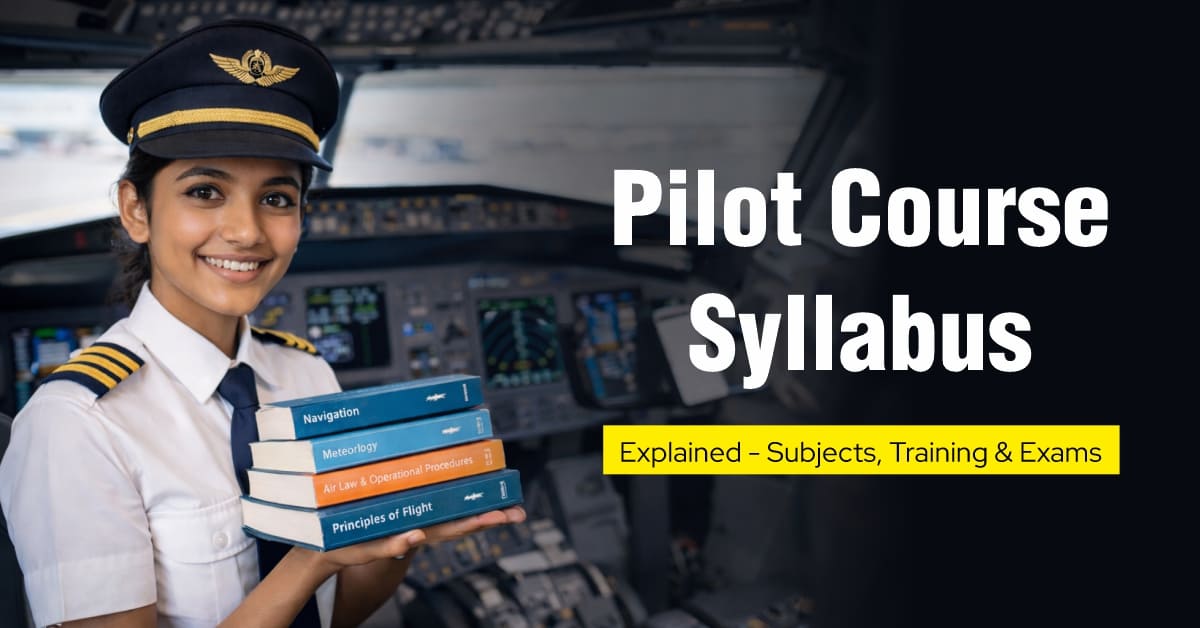
Pilot Course Syllabus Explained Subjects, Training & Exams
Posted on : 12 April, 2026 03:10 pm
The dream of becoming a pilot requires more than passion—it demands rigorous training and knowledge across multiple aviation subjects. The pilot course syllabus is designed to balance theoretical learning with practical flying experience. Whether you’re pursuing a Private Pilot License (PPL), Commercial Pilot License (CPL), or Airline Transport Pilot License (ATPL), the foundation remains the same: safety, precision, and professionalism. Below is a detailed look at the pilot course syllabus.
1. Ground Training Syllabus
Ground training equips students with the theoretical knowledge needed to operate safely in the sky.
- Air Regulations: Rules of the air, licensing requirements, and aviation law (DGCA/FAA/ICAO guidelines).
- Air Navigation: Maps, charts, radio aids, dead reckoning, and flight planning techniques.
- Meteorology: Study of weather systems, clouds, winds, and aviation hazards.
- Aircraft & Engines: Understanding aircraft systems, aerodynamics, and propulsion.
- Air Traffic Control (ATC) Procedures: Communication, phraseology, and navigation assistance.
- Human Performance & Limitations: Psychology, physiology, and the effects of altitude on the human body.
- Aviation Meteorological Instruments: Use of barometers, altimeters, and weather radars.
- Radio Telephony (RT): Standard communication techniques with ATC using aviation phraseology.
Ground training typically spans 6 to 8 months, depending on the license being pursued.
2. Flight Training Syllabus
Practical flying is the heart of pilot training, where students turn theory into hands-on skills.
- Initial Flying Lessons: Introduction to cockpit controls, taxiing, and basic maneuvers.
- Takeoff and Landing Practice: Safe handling during critical phases of flight.
- Solo Flying: Building confidence by flying alone under supervision.
- Cross-Country Flying: Long-distance navigation and fuel management.
- Instrument Flying: Training to fly with reference to instruments only, especially in poor visibility.
- Night Flying: Handling takeoffs, landings, and navigation in night conditions.
- Emergency Procedures: Simulated engine failures, forced landings, and recovery from stalls.
- Multi-Engine Training (For CPL/ATPL): Learning to fly aircraft with more than one engine.
Flight training usually requires 200 hours for CPL and more for advanced licenses, as per regulatory authority guidelines.
3. Simulator Training
Simulators replicate real cockpit scenarios without the risks of actual flying.
- Practicing instrument flying, navigation, and emergency drills.
- Familiarization with modern avionics and flight management systems.
- Building decision-making skills under pressure.
Simulator hours are often counted towards total flight training requirements.
4. Examinations and Assessments
Every pilot course includes written exams, oral tests, and flying checks.
- Written Exams: Conducted for air regulations, meteorology, navigation, and aircraft systems.
- Radio Telephony Test: Certification in ATC communication.
- Flying Tests: Final check rides with examiners to demonstrate skills.
Passing these ensures eligibility for the respective pilot license.
The pilot course syllabus is a well-balanced blend of ground theory, flight practice, and simulator training. It covers every detail a pilot must know—from reading weather patterns and communicating with ATC to handling emergencies and mastering cross-country flights. This rigorous curriculum ensures that by the time a student earns their wings, they are not only skilled in flying but also disciplined, knowledgeable, and prepared for real-world aviation challenges. With dedication and the right training, the syllabus becomes more than just a course—it becomes the roadmap to a successful aviation career.