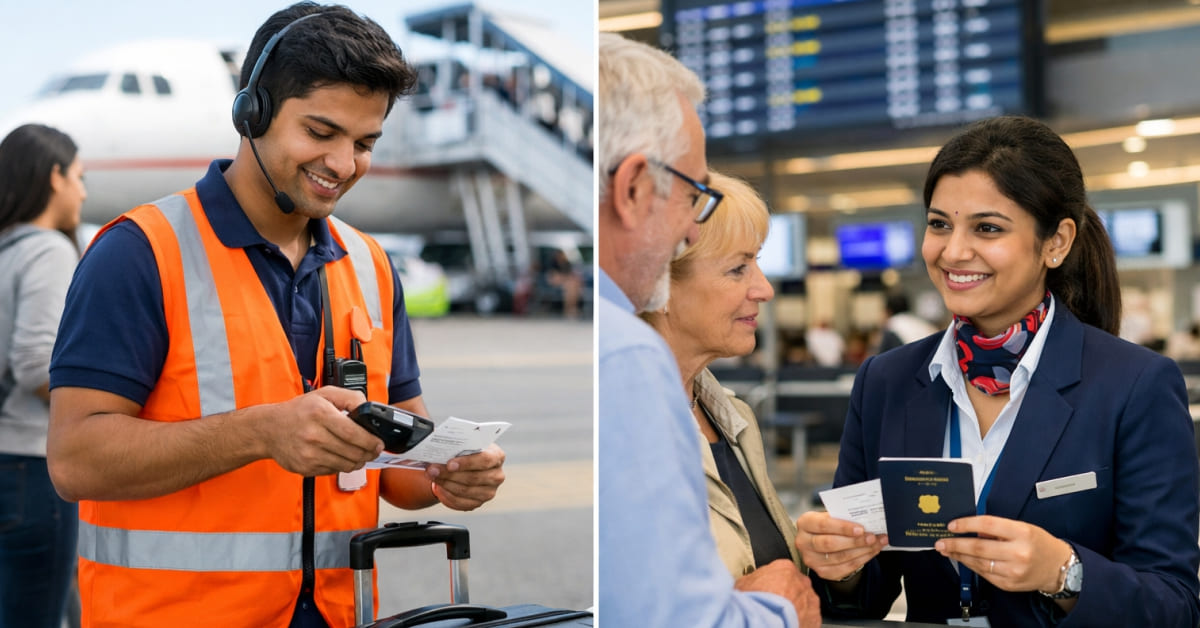
Ground Staff Duties Compared: Domestic Terminals vs. International Hubs
Posted on : 12 March, 2026 11:56 am
Ground staff are the pillar of smooth airport management. Whether its a small domestic terminal or a bustling international hub, their responsibilities are crucial for passenger satisfaction, safety, and regulatory compliance. However, the nature and scope of their duties vary significantly depending on the type of airport they work at.
1. Passenger Documentation and Verification
Domestic Airports
At domestic airports, documentation checks are relatively simple. Ground staff mainly verify government-issued ID cards and confirm ticket details. There’s no need to check visas or passports, which simplifies boarding procedures.
International Hubs
International operations involve stringent documentation processes. Ground staff must check:
- Passport validity
- Visa requirements
- Transit permits
- COVID-19 or health-related certificates (where applicable)
2. Coordination with Authorities
Domestic Airports
Coordination is typically limited to airport security and airline operations teams. There’s less involvement with customs or immigration authorities.
International Hubs
Ground staff regularly coordinate with:
- Immigration officers
- Customs authorities
- Foreign embassy representatives (in some cases) They often serve as intermediaries when passengers face issues with entry requirements or documentation.
3. Baggage Handling and Customs Procedures
Domestic Airports
Baggage handling is more straightforward. Theres no need for customs declarations, and domestic flights usually have faster baggage turnaround times.
International Hubs
Ground staff must ensure compliance with customs regulations. Their responsibilities include:
- Monitoring baggage for restricted or declared items
- Directing passengers to customs declaration lanes
- Assisting with lost or delayed baggage across international carriers
4. Language and Cultural Sensitivity
Domestic Airports
Staff usually interact with passengers who share a common language and cultural context, which simplifies communication.
International Hubs
Staff deal with a highly diverse group of travelers. They must often:
- Communicate in English or multiple languages
- Understand different cultural expectations
- Provide assistance with local customs or transfer procedures
5. Training and Compliance Requirements
Domestic Airports
While training is essential, the focus is more on basic operational procedures, safety, and customer service.
International Hubs
Ground staff must undergo extensive training in:
- International security protocols
- Dangerous goods handling
- Immigration and customs regulations
- Airline alliance and interline procedures
While the core responsibilities of ground staff remain centered around passenger service and operational support, the complexity increases significantly at international hubs. From document checks and customs coordination to language skills and compliance training, working at an international airport demands a broader skill set and higher level of precision. Understanding these differences is key to appreciating the vital role ground staff play in both domestic and global aviation.