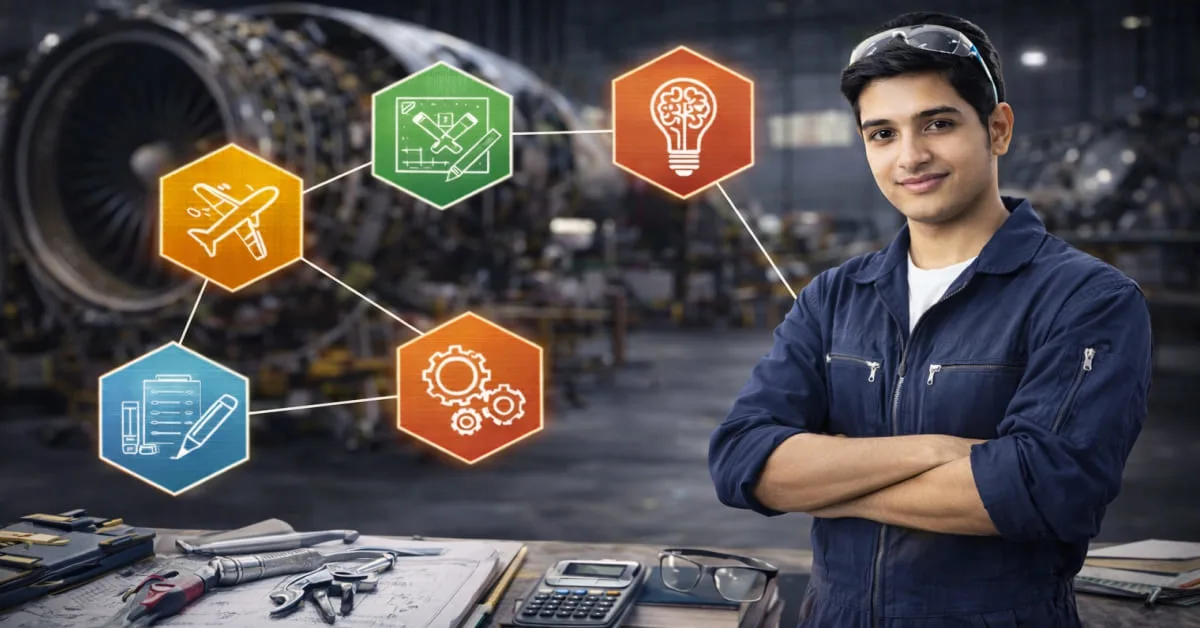
Essential Skills Required to Become an Aeronautical Engineer
Posted on : 19 January, 2026 06:25 pm
Aeronautical engineering is one of the most dynamic engineering disciplines, focusing on the design, development, and maintenance of aircraft and related technologies. Students aspiring to work in this field need to have more than mere academic knowledge; a strong technical and soft skill set will be required to earn a comfortable livelihood.
Strong Foundation in Mathematics and Physics
Aeronautical engineering is built on the principles of both mathematics and physics. The critical concepts are aerodynamics, fluid mechanics, propulsion, and structural analysis. Problem-solving, analytical thinking, and understanding the complex aircraft system are much easier for analytical minds.
Proficiency in Technical Software
Modern aeronautical engineers must be skilled in computer-aided design (CAD) and simulation tools. Knowledge of software like CATIA, ANSYS, MATLAB, and AutoCAD is highly valued, as these tools assist in modeling, designing, and testing aircraft components before they are physically built.
Problem-Solving and Analytical Thinking
Aircraft design involves critical challenges such as reducing fuel consumption, improving safety, and enhancing efficiency. Engineers must be able to think logically, analyze data, and come up with innovative solutions to these complex problems.
Knowledge of Aerodynamics and Materials
A deep understanding of aerodynamics, propulsion systems, and materials science is crucial. Engineers should know how different materials perform under high pressure, temperature, and stress to ensure safety and durability in aircraft manufacturing.
Attention to Detail
Precision is vital in the aviation industry. A small error in design or calculation can lead to major consequences. Aeronautical engineers must pay close attention to details while designing and testing aircraft systems.
Communication and Teamwork
Aeronautical projects often involve collaboration among multidisciplinary teams, including engineers, scientists, and technicians. Effective communication and teamwork skills are necessary to ensure smooth coordination and project success.
Creativity and Innovation
In the aviation industry, life is about innovations. Design of things like energy-efficient aircraft or UAVs: creativity is what builds a technology and enhances an existing one.
Adaptability and Continuous Learning
With rapid dynamics across aerospace technology, aeronautical engineers must never rather working without updating their knowledge and skills. Practical adaptability to a new tool, trend, or method is what works best for long-term existence. Balancing technical knowledge with problem-solving and interpersonal skills will assure a successful career in aeronautical engineering. Students who will make sure they nurture the necessary abilities are hence bound to not only excel in their academic studies but also look forward to a rewarding career in aviation and aerospace, a domain ever in flux.