Emerging Technologies in Aircraft Maintenance Engineering
Posted on : 5 March, 2026 10:13 am
The aviation industry is evolving rapidly, and technology is playing a major role in this transformation. Aircraft Maintenance Engineers (AMEs), who are responsible for ensuring aircraft safety and airworthiness, must adapt to these changes. With the rise of advanced tools and digital systems, AMEs are entering a new era where technology enhances efficiency, accuracy, and safety.
Here are some points for Emerging Technologies in AME:
- Digital Transformation in Maintenance
- Advanced Inspection Techniques
- Smart Materials and Sensors
- Virtual and Augmented Reality (VR/AR)
- Automation and Robotics in MRO
- Sustainability and Green Technologies
Digital Transformation in Maintenance
Modern aircraft generate vast amounts of data every flight. With Artificial Intelligence (AI) and Machine Learning (ML), this data can be analysed to predict potential issues before they occur. This process, known as predictive maintenance, helps reduce downtime and lowers costs. Big Data analytics also enables engineers to track performance trends, while cloud-based systems make it easier to share real-time aircraft health data across maintenance teams worldwide.
Advanced Inspection Techniques
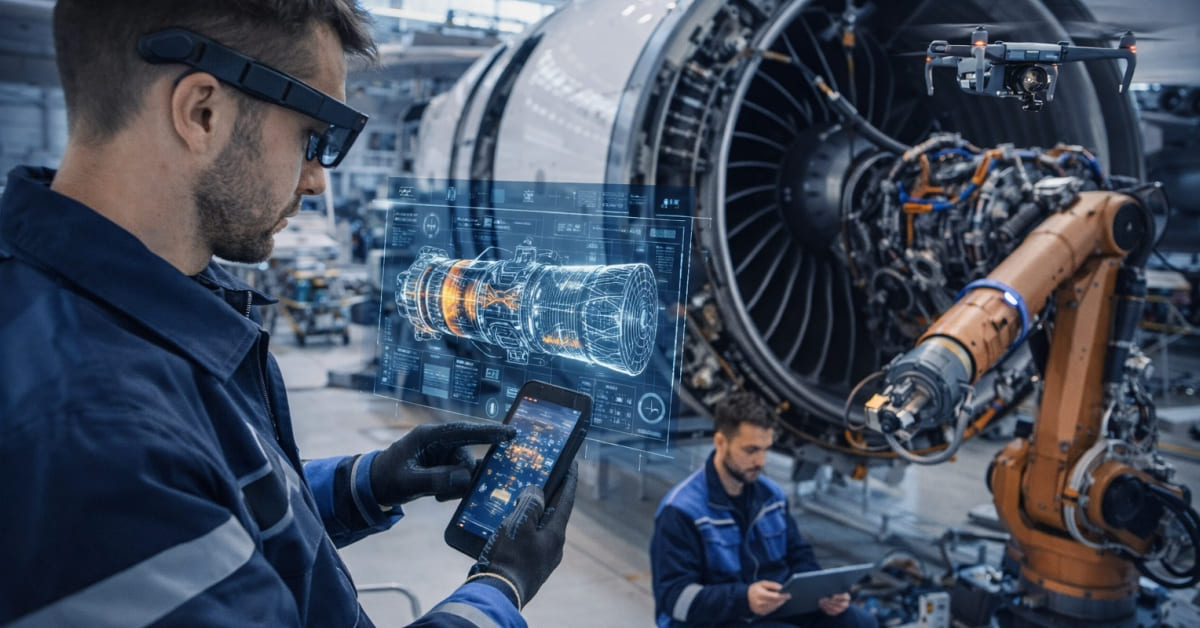
Traditional inspection methods are being replaced with smarter alternatives. Drones and robotics are now used for external aircraft inspections, making the process faster and safer. Non-Destructive Testing (NDT) techniques, such as ultrasound or X-ray, help detect hidden cracks or material weaknesses without damaging parts. In addition, 3D scanning and imaging technologies are improving the precision of structural checks.
Smart Materials and Sensors
The increasing use of composite materials in aircraft demands new maintenance practices. These materials are lighter yet stronger but require specialized inspections. Aircraft are also being equipped with smart sensors that continuously monitor engines, hydraulics, and avionics. With the help of the Internet of Things (IoT), these sensors send live data to engineers, enabling quicker fault detection and repair.
Virtual and Augmented Reality (VR/AR)
Training for AMEs is becoming more advanced with Virtual Reality (VR) simulations, which allow students to practice real-life scenarios in a safe environment. Augmented Reality (AR) is also being used in daily maintenance work, where engineers can view interactive manuals and step-by-step guidance directly through smart glasses. This reduces human error and improves efficiency during complex tasks.
Automation and Robotics in MRO
In the Maintenance, Repair, and Overhaul (MRO) industry, automation and robotics are transforming operations. Robotic arms are now capable of handling component repairs and precision drilling, while automated inspection tools reduce turnaround time. This technology ensures higher accuracy and safety while minimizing human fatigue.
Sustainability and Green Technologies
With the aviation industry focusing on sustainability, AMEs will soon work on electric and hybrid aircraft. Maintaining eco-friendly engines and materials will be a new challenge. Green maintenance practices, such as recycling materials and reducing chemical use, are also becoming part of standard procedures.
Emerging technologies are reshaping the world of Aircraft Maintenance Engineering. From AI and robotics to AR training and sustainable practices, these advancements are making maintenance faster, safer, and more efficient. For AMEs, this evolution means continuous learning and adaptation-but it also opens the door to global opportunities. In the future, skilled AMEs who embrace technology will remain at the forefront of aviation safety and growth.