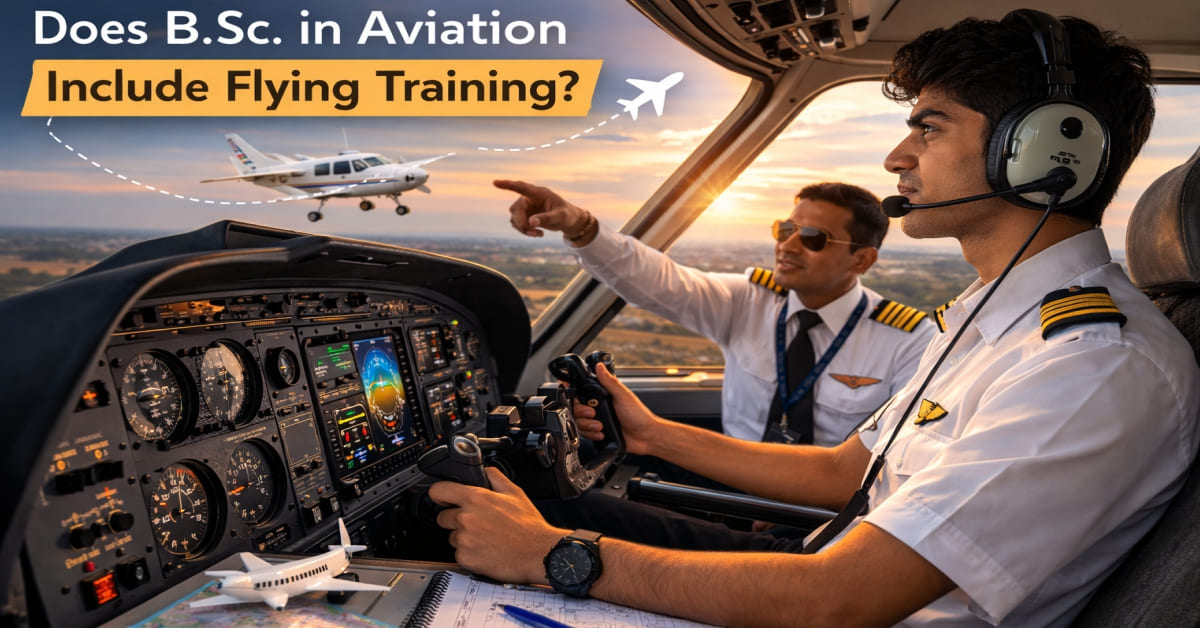
Does B.Sc. in Aviation Include Flying Training?
Posted on : 15 March, 2026 12:37 pm
A B.Sc. in Aviation is one of the most sought after undergraduate programs for students who dream of building a career in the aviation industry. It offers a blend of theoretical knowledge and practical exposure in areas like airport operations, airline management, air traffic control, safety and aviation regulations. However, one of the most common questions students ask is: Does the B.Sc. in Aviation include flying training?
The Focus of B.Sc. in Aviation
The core objective of a B.Sc. in Aviation program is to provide students with the academic foundation and technical skills required for ground and management roles in aviation. Subjects usually include:
- Aviation Meteorology
- Navigation and Air Traffic Control
- Airport and Airline Management
- Aviation Safety and Security
- Aircraft Maintenance Basics
- Aviation Law and Regulations
This means the program is more management and operations oriented rather than focused on flying.
Flying Training in B.Sc. Aviation: The Reality
In the case of B.Sc. in Aviation, it is rare to have the course include pilot training and flying classes. Flying training is a specialized area that requires proper licensing and training under directed and approved DGCA flying schools in India, FAA in the USA or EASA in Europe. However, integrated programs catering to B.Sc. in Aviation and flight training are offered only by a few aviation academies and are not widely recognized. Though such programs exist, they are more expensive as compared to regular B.Sc. in Aviation.
How to Become a Pilot After B.Sc. Aviation?
If your goal is to fly, a B.Sc. in Aviation can still be beneficial as it gives you deep knowledge of the industry. After completing your degree, you can:
- Enroll in a DGCA approved Flying School.
- Undergo 200+ hours of flight training to qualify for a Commercial Pilot License (CPL).
- Clear required written exams, medicals and simulator training.
With both a B.Sc. degree and CPL, youll have dual advantages a strong academic base and the professional license to fly.
Alternative Pathways
Students who want flying training as a primary goal may choose:
- Sc. in Aviation with Pilot Training (if available at specific institutions).
- Dedicated Pilot Training Courses after 12th grade (with PCM).
- Diploma or Certificate in Pilot Training without pursuing a degree.
Typically, B.Sc. in Aviation does not entail flying license training. Rather, it involves studies of operations, safety, and management aspects of the aviation sector. Nonetheless, the course can be beneficial to flying license training (CPL) and is best pursued alongside it. Piloting aspirants must make a clear schedule and choose either an integrated course or standalone flying training after their graduation.