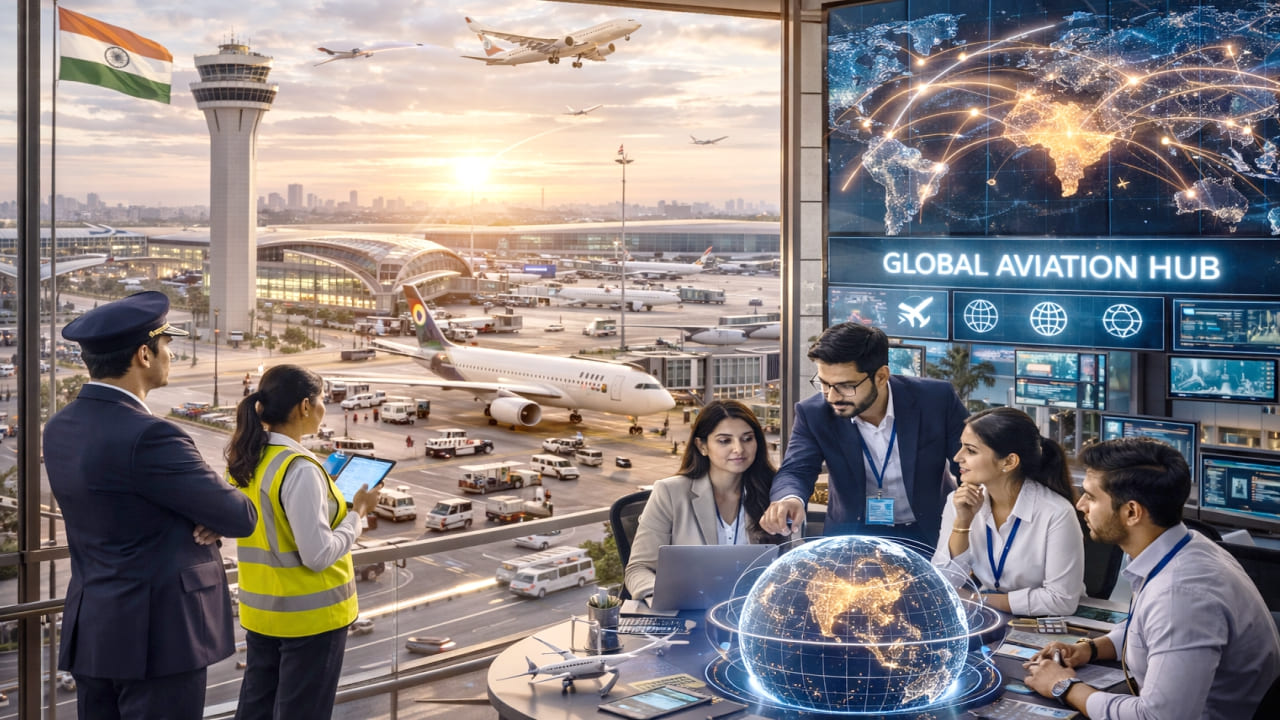
Can India Become the Next Global Aviation Hub?
Posted on : 17 April, 2026 11:44 am
Indias aviation industry is at a pivotal stage of transformation. With rapid economic growth, increasing passenger traffic, modern infrastructure development, and supportive government policies, the country is positioning itself as one of the most promising aviation markets globally. But the crucial question remains:
Can India evolve into the next global aviation hub? The answer lies in how effectively India leverages its strengths and addresses its challenges.
Strategic Geographic Advantage
Indias location is one of its biggest assets. Situated between Europe, the Middle East, and Southeast Asia, India is naturally positioned to serve as a major transit point for long-haul flights. For airlines operating on Europe-Asia or North America-Asia routes, Indian airports could become ideal connecting hubs. With international carriers increasingly recognizing Indias potential, strengthening its role as a global stopover destination is both achievable and strategic.
Expanding World-Class Infrastructure
India is making unprecedented investments in aviation infrastructure. Airports like Delhis Indira Gandhi International Airport and Mumbais Chhatrapati Shivaji Maharaj International Airport are already among the busiest in Asia. Upcoming mega projects such as the Noida International Airport at Jewar and Navi Mumbai International Airport are designed with cutting-edge facilities to handle over 70 million passengers annually.
Additionally, the governments UDAN (Ude Desh ka Aam Nagrik) scheme is enhancing regional connectivity by linking tier-2 and tier-3 cities with major hubs, thereby increasing passenger flow to metropolitan airports. With over 100 airports already operational and plans for 200+ airports by 2040, India is laying the foundation for hub-level traffic management.
Booming Passenger Demand
India is currently the third-largest domestic aviation market in the world and is projected to surpass even the United States in the coming decades. Rising disposable income, a growing middle class, and increasing urbanization are fueling passenger growth. By 2030, India is expected to handle nearly 1.1 billion passengers annually, according to IATA (International Air Transport Association).
The dominance of low-cost carriers (LCCs) like IndiGo, which already controls over 60% of the domestic market, along with expanding international routes by Air India, Akasa Air, and Vistara, reflects Indias increasing role in global aviation.
Supportive Government Policies
The Indian government has introduced several reforms to strengthen aviation:
- 100% FDI allowance in aviation infrastructure.
- Open Skies agreements to encourage more international flights.
- Privatization of airports to improve service standards.
- Incentives for sustainable aviation fuels (SAF) and green airports.
These initiatives are attracting international investors and creating an environment where India can scale up to global aviation standards.
Cargo and Logistics Potential
- Beyond passenger traffic, India has huge potential in air cargo and logistics, especially with the rise of e-commerce. The governments National Air Cargo Policy Outline (NACPO) aims to make India one of the top five airfreight markets by 2025. Strategically located airports like Hyderabad and Bengaluru are already emerging as cargo hubs, which will further enhance Indias global aviation significance.
Challenges Ahead
Despite strong growth, India must overcome some hurdles to achieve hub status:
- High Aviation Turbine Fuel (ATF) costs, which increase airline operating expenses.
- Airspace congestion and limited parking slots at metro airports.
- Need for skilled manpower, including pilots, engineers, and aviation managers.
- The requirement for stronger global partnerships and more long-haul direct routes.
Addressing these challenges with regulatory reforms, fuel tax rationalization, and workforce training will be crucial to sustaining momentum.
Conclusion
India has all the right ingredients to become the next global aviation hub-a strategic location, booming passenger demand, rapidly expanding infrastructure, and supportive government policies. By focusing on sustainable aviation practices, enhancing cargo capacity, and fostering international collaborations, India can compete with global leaders like Dubai, Singapore, and Doha. If challenges are addressed proactively, India is not just on track to be a major player-it is poised to redefine the future of global aviation.