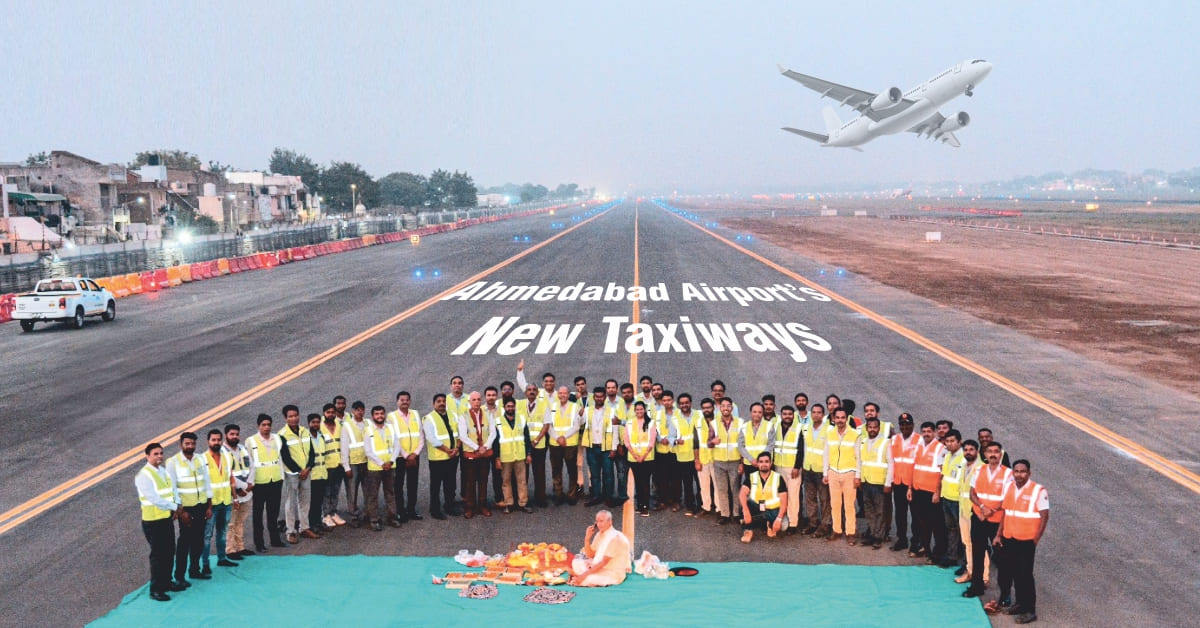
Ahmedabad Airport’s Big Leap: Why the New Taxiways Matter
Posted on : 10 December, 2025 06:57 pm
On November 27, 2025, a big leap forward was taken by SVPIA (Sardar Vallabhbhai Patel International Airport) when it commissioned two new parallel taxiways, named Taxiway R and Taxiway R1. These are “Codeâ¯C” taxiways, built in compliance with the standards of DGCA and ICAO, and are tailored to handle the kind of narrow body aircraft that constitute the bulk of flights at Ahmedabad — such as the Airbusâ¯A320 and Boeingâ¯737. With this addition, the runway handling capacity of the airport has increased by 40% - rising from about 20 air traffic movements per hour to 28 ATMs per hour. Quite simply put: SVPIA has become far more efficient and future-ready, and this upgrade will ripple out to airlines, passengers, and Indias aviation ecosystem as a whole.
What Changed: From Backtracking to Smooth Flow?
The Old Bottleneck: Runway Backtracking
Prior to the new taxiways, nearly every departing aircraft-and many arriving ones-had to "backtrack" on the runway: this means after push back or landing, planes would taxi onto the runway, travel to its end, make a U-turn and then line up for take-off. This added 2-3 extra minutes to each movement. The backtracking in such a manner meant that the runway occupied longer time per flight. During busy hours, this oftentimes translated into slower arrivals and departures, holding patterns in the air for inbound flights, and general delays that affect the overall schedule.
The New Reality: Parallel Taxiways = Faster, Safer, Greener
Thanks to the 1,126-metre-long Taxiwayâ¯R and Taxiwayâ¯R1, leading directly to Runway 05/23, about 95% of all Code C aircraft at SVPIA can reach the runway without backtracking. What it means is that aircraft can taxi in and out through these parallel taxiways, greatly reducing the runway occupancy time. The result-a smoother flow of arrivals and departures, less waiting, and far fewer chances of runway conflicts. Now, because the runway is freed up more quickly, the airport can handle many more flights per hour. Another advantage: it increases predictability. It makes on time performance more reliable, which is a big plus for airlines and travellers alike. Plus, reduced ground-time, fewer delays and more efficient sequencing all combine to result in less fuel burn, lower emissions, and reduced environmental footprint
What It Means for Passengers & Airlines?
- Faster, more reliable flights: With less runway congestion and better sequencing, departures and-arrivals are more likely to stick to schedule. Travellers could see fewer delays.
More flights, more connectivity: A higher capacity gives airlines room to add more flight slots. That could translate into increased frequency on existing routes or even new routes out of Ahmedabad.
- Better use of resources and convenience: quicker aircraft turnover, better stand allocation, and efficient ground movements-all combine into easier operations for the airlines. That ease could trickle down to passengers, too-scheduling might improve, fares could be better, or flights more frequent.
- Environmental and safety gains: Shorter runway occupancy reduces fuel burn and emissions. Fewer runway conflicts make operations safer and more predictable. Moreover, with a capacity upgrade, taking into consideration that between April and October 2025, SVPIA handled about 7.8 million passengers-a 7% year-on-year increase-this could not have come at a better time.
A Sign of India’s Bigger Aviation Growth Story
The upgrade at SVPIA isnt an isolated case. It reflects a broader trend: Indias aviation infrastructure catching up with, and trying to stay ahead of, rapidly rising demand. The move aligns with the ongoing effort to modernize airports, improve capacity, and make sure the aviation sector is in a position to handle growth sustainably and efficiently. For a city like Ahmedabad, which is already a big regional hub, having world-standard taxiways bolsters its aviation credentials. More airlines, more routes, and better connectivity may follow, adding to the business, tourism, and regional growth over time.
What This Means for You (as a Travelers or AviationâÂÂÂÂÂÂObserver)?
The ground operations will be smoother, flights may increase, and the chances of delays caused by runway congestion will also decrease if the travel is via Ahmedabad airport.
- For airlines, a more efficient runway and taxiway network will equate to cost savings and better flexibility in scheduling, as well as slot optimization.
- It contributes towards the aviation vision of India: Infrastructure upgrades in this manner indicate that the airports are not superficial expansion works but rather reengineering towards global standards - DGCA, ICAO - thereby ensuring long-term viability.
For those who keep tabs on Indian aviation, this is just another sign that the sector is modernizing, evolving, and preparing for a future of high traffic, more routes, and greater efficiency.
Conclusion: A Step Forward for Aviation in Ahmedabad and India
The commissioning of Taxiways R and R1 at SVPIA is a turning point. What might seem like "just another airport upgrade" is, in fact, carefully planned and much-needed enhancement that deepens capacity, amplifies efficiency, and future proofs one of Gujarats most important aviation hubs. These benefits will materialize over time for passengers, airlines, and aviation stakeholders alike: less delays, more flights, better connectivity, and maybe even greener operations. With air travel demand continuing to soar and most airports in India striving to catch up with the demand, this new development highlights how critical upgrading infrastructure has become. In fact, SVPIAs leap forward is a small but significant milestone in Indias larger aviation journey. If you like, I can also draft a version of this blog in Hindi-keeping the same structure and subheadings-which might be useful should you want to share on Indian language blogs or social media.