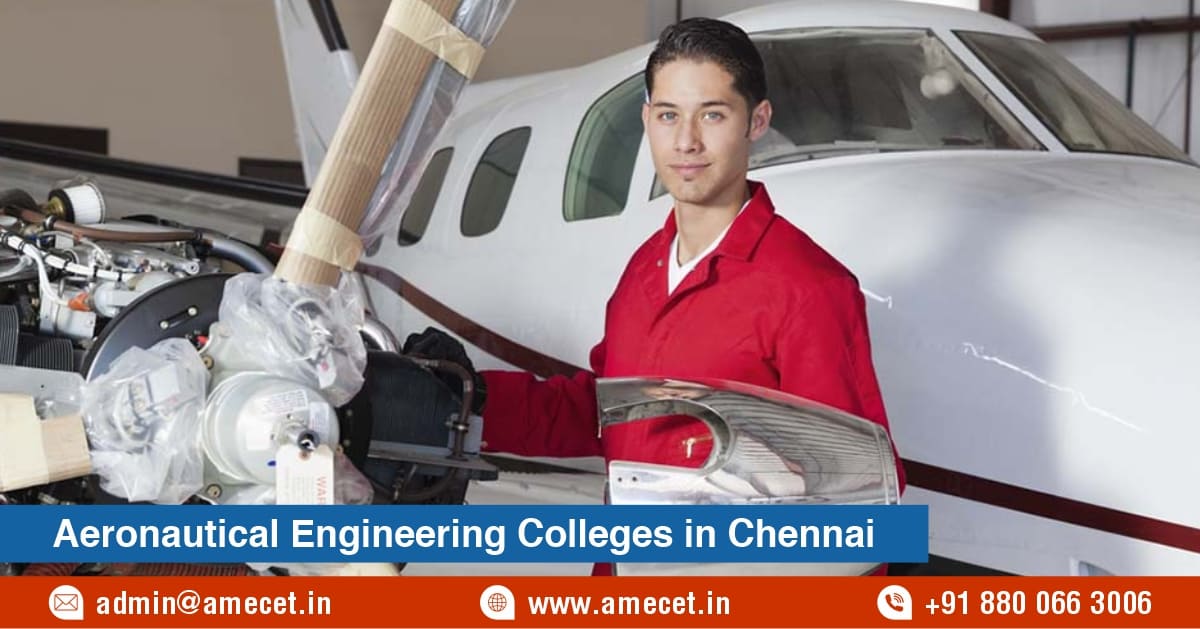
Chennais strong industrial presence, reputable universities, and expanding aerospace industry make it a top choice for students wishing to pursue aeronautical engineering. Some of the best colleges for aeronautical engineering are located in the city; they provide top-notch instruction with an emphasis on hands-on training, research, and innovation. Due to Chennais significant aerospace companies, research facilities, and defense agencies, students have access to beneficial internship and employment opportunities. Learning is further improved by the availability of state-of-the-art simulation facilities, wind tunnels, and laboratories. Chennai is also a center for Indias aviation and aerospace development due to its advantageous location and connectivity. Students from all over the country are drawn to the city by its reasonably priced living and educational expenses. A successful career in the aviation sector is guaranteed when choosing Chennai for Aeronautical Engineering.
Eligibility Criteria for Aeronautical Engineering in Chennai
Candidates must fulfill particular eligibility requirements established by universities and colleges in order to pursue aeronautical engineering in Chennai. Students should typically have finished their 10+2 coursework with PCM (physics, chemistry, and mathematics) as their core subjects. The minimum aggregate is between 50 and 60 percent, though the cut-offs may be higher for elite institutions. Admission may require entrance exams such as JEE Main, AME CET, TNEA, or university-level assessments. Applicants for lateral entry into the second year may also be diploma holders in related engineering fields. Before making a final decision, some universities might also hold in-person interviews or counseling sessions.
Key Points:
Must have passed 10+2 (PCM) with at least 50-60% aggregate
JEE Main, AME CET, TNEA, or other entrance exams may be required
Diploma holders in relevant fields can apply for lateral entry
Some institutes conduct interviews or counseling rounds
Minimum age limit is usually 17 years
Students should have strong mathematical and analytical skills
Candidates from science backgrounds are preferred
Some colleges may require medical fitness certification
Course Duration and Structure of Aeronautical Engineering
For a B.Tech/B.E. degree, the Aeronautical Engineering program normally consists of eight semesters and four years. Core subjects, hands-on training, and project work are all covered by students. By using lateral entry, diploma holders can shorten the time to three years. Laboratory sessions, internships, and theoretical classes are all part of the curriculum. There is coverage of specialized topics like avionics, propulsion, aerodynamics, and aircraft structures. A significant project and industrial training for practical experience are frequently included in the final year.
Key Points:
4-year undergraduate program (B.Tech/B.E.)
8 semesters with theoretical & practical training
3-year course for lateral entry diploma holders
Includes core subjects like aerodynamics and avionics
Internships and industrial training are mandatory
Final year project for research and innovation
Laboratory sessions for hands-on experience
Exposure to aircraft design, maintenance, and testing
A combination of foundational sciences, core engineering courses, and specialized topics are covered in the Aeronautical Engineering curriculum. Math, physics, chemistry, and fundamental engineering concepts are the main topics of the first two years. Students study flight mechanics, avionics, propulsion, aerodynamics, and aircraft structures in the later semesters. Unmanned aerial vehicles (UAVs), avionics systems, aerospace propulsion, and aircraft design are among the specialties. Learning is improved through hands-on training in labs, simulations, and internships. In order to prepare students for careers in aviation and aerospace technology, the curriculum is in line with industry demands.
Key Points:
Basic sciences in the initial semesters
Core engineering subjects like thermodynamics and fluid mechanics
Aerodynamics and propulsion in later semesters
Avionics and flight mechanics as advanced topics
Specializations include aircraft design & UAVs
Practical labs for real-world applications
Internships for hands-on experience
Industry-aligned curriculum for job readiness
Career Opportunities After Aeronautical Engineering in Chennai
Career options for Chennai graduates in aeronautical engineering are varied and include positions in research, defense, aerospace, and aviation. Job opportunities are good because Chennai is home to top aerospace companies, MRO (Maintenance, Repair, and Overhaul) facilities, and defense establishments. Engineers can work in quality control, avionics, propulsion systems, and aircraft design. There are opportunities at private firms like Airbus, Boeing, and Tata Aerospace as well as government organizations like DRDO, ISRO, and HAL. To further their careers, many graduates also go on to further their education or conduct research.
Key Points:
Aircraft design and manufacturing
Aerospace propulsion and avionics engineering
Opportunities in ISRO, DRDO, and HAL
Roles in MRO and airline maintenance
Private sector jobs in Airbus, Boeing, etc.
Scope in UAV and drone technology
Higher studies in aerospace disciplines
Research and development opportunities
Chennais top aerospace companies, MRO facilities, and research organizations make it a great place to pursue a career in aeronautical engineering. Graduates can investigate opportunities in the public and private sectors in the areas of propulsion systems, avionics, aircraft design, and quality control. The future of aeronautical engineers is bright because of the presence of major companies in India, including ISRO, DRDO, HAL, Airbus, and Boeing.
New growth opportunities are being created by the fields expansion into drone technology, UAV development, and space exploration. Career prospects can also be further improved by pursuing further education or research. Chennai is a top choice for students aspiring to pursue careers in aeronautical engineering who want to succeed in the aviation and aerospace industries because of its solid industrial ties and top-notch academic program.